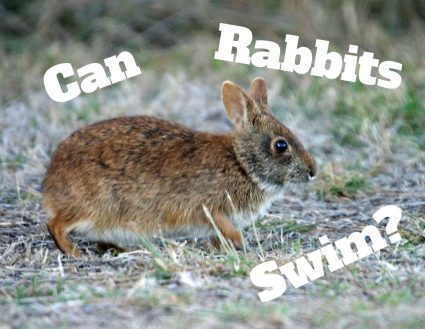
With their long ears and fluffy white tails, rabbits are pretty recognizable. You’ve probably seen one in the wild, or maybe you even have a pet bunny! But did you know there are 29 species of rabbits worldwide?

An eastern cottontail rabbit–just one of 29 species of rabbits. Photo by MattCuda / iStock.com.
Rabbits vary greatly in size. The smallest rabbit, the pygmy rabbit, is only about 24 cm (9.3 in.) long and 375 g (.8 lb.) in weight.
The largest rabbit on record is a Continental Giant breed of domestic rabbit named Darius. He is 1.3 m (4.3 ft.) long and weighs over 23 kg (50 lb.)!
Typically, wild rabbits have agouti-colored (brown-gray) fur. But some species are black, like the Amami rabbit in Japan, or black-striped, like the Sumatran striped rabbit or the Annamite striped rabbit in southeast Asia.

Some species of rabbits, like this Amami rabbit in Japan, have black fur. Photo by Wich’yanan (Jay) Limparungpatthanakij, CC BY 4.0, via Wikimedia Commons.
Where Rabbits Live
Wild rabbits live on every continent except Antarctica. In Australia, they are an invasive species, brought there by British settlers in the 1700s.
Rabbits can be found in a variety of habitats, including forests, thickets, shrublands, wetlands, and deserts.
Many rabbits live in underground burrows called warrens. These warrens may have extensive tunnels and chambers. But some species, like cottontails, use other animals’ burrows or just take cover under some brush.
How Rabbits Move
In general, rabbits move by hopping. They have powerful hind legs and flexible spines.
When rabbits hop, they push off with their hind feet, leaping forward with their body and legs outstretched. Then they bring both hind feet in front of their front feet to push off again.

A European rabbit mid-hop. Photo by MikeLane45 / iStock.com.
They can reach speeds of about 40 km/h (25 mph).
But did you know that rabbits can also walk? Rabbits may walk when they are cautiously exploring an area. They keep their body low to the ground and then tiptoe forward.
When rabbits are happy or excited, they do big acrobatic leaps in the air called binkies.
Wild rabbits also have the ability to swim. They may take to the water to evade predators. Some rabbits, like the swamp rabbit and the marsh rabbit, can swim exceptionally well.

Marsh rabbits, like this one, are excellent swimmers. Though they can hop, they often walk or swim while navigating through their wetland habitat. Photo by Everglades NPS from Homestead, Florida, United States, Public domain, via Wikimedia Commons.
Rabbit Senses
Rabbits are prey animals and rely heavily on their senses to evade predators.
They have a very sharp sense of hearing, and they can swivel their ears independently to hone in on two sounds at once. Their large ears funnel the sounds into their ear canals allowing them to hear things very far away.
In addition, they also have an excellent sense of smell. They have millions of scent cells in their noses. When they wriggle their noses, they’re able to pick up many different scents in the air.
Rabbits also have a very wide range of vision. With eyes located on the sides of their heads, they have an almost 360° field of vision.
But because rabbits’ eyes are on the sides of their heads, it means they can’t see well right in front of them. Luckily, they also have whiskers for detecting objects directly in front of their faces.
What Wild Rabbits Eat
Wild rabbits primarily eat grasses, but they also graze on clover, leafy greens, and fruit.

Rabbits, like this cottontail, primarily eat grass. Photo by mirceax / iStock.com.
Rabbits are crepuscular, which means they are most active at dawn and dusk. They spend six to eight hours per day grazing.
To keep up with the wear and tear of continuous grazing, rabbits’ teeth never stop growing.
Why Rabbits Eat Their Own Poop
Rabbits engage in an activity that you may find a bit gross: they eat their own poop! When animals eat their own poop, it’s called coprophagy.
Rabbits eat their own poop in order to get enough nutrients out of their diet. Because rabbits mainly eat grass, their diet is very fibrous and not very nutrient-dense.
When rabbits eat grass, it goes through their digestive system and exits their body as a special kind of soft poop called a cecotroph. Cecotrophs are shaped like tiny bunches of grapes.
Rabbits eat the cecotrophs directly from their behinds. Once that passes through their digestive system, the resulting poop is in the form of hard round pellets.
Rabbits as Pets
All pet rabbits descended from the European rabbit. There are now hundreds of rabbit breeds encompassing many sizes and colors of bunnies.
Pet rabbits can be small, like this dwarf bunny:

Dwarf rabbit. Photo by Olga Smolina / iStock.com.
Or they can be large, like this Flemish giant:

Flemish giant rabbit. Photo by krithnarong / iStock.com.
Some rabbits were bred to have floppy ears, like this lop-eared rabbit:

Holland lop rabbit. Photo by Alice Wanwarameth / iStock.com.
Rabbits in Captivity
In addition to keeping rabbits as pets, people keep domesticated rabbits as livestock to eat or for their fur.
Rabbits have also been used in laboratories for medical research and to test the safety of drugs and other medicines.
Are Rabbits Rodents?
Contrary to popular belief, rabbits are not rodents. Rabbits are classified in the order Lagomorpha along with hares and pikas.
They differ from rodents because they have four top front teeth instead of two.
What’s the Difference Between a Rabbit and a Hare?
Rabbits and hares are very similar and are classified together in the Leporidae family. They both are both herbivores with long ears, fluffy tails, and powerful hind legs.
But hares have longer ears and longer legs than rabbits. They are also able to hop faster.
What’s the Difference Between a Rabbit and a Bunny?
There’s no difference between a rabbit and a bunny. ‘Bunny’ is just another term for rabbit. The two words can be used interchangeably.
Reproduction
When a female rabbit, called a doe, becomes pregnant, she makes a nest of grass and fur. After a gestation period of 31 days, she gives birth to a litter of about five babies, called kittens or kits.
The kits are born blind and hairless. They begin to grow fur after a few days. When they are about one to two weeks old, they open their eyes.
The mother rabbit nurses her young just twice a day. She is careful not to draw too much attention to the nest.

Baby rabbits are called kits or kittens. Photo by wendue / iStock.com.
After three weeks, the baby bunnies are ready to live on their own.
In the wild, rabbits live about two years. In captivity, they typically live up to 12 years.
They have many predators, including foxes, dogs, bobcats, birds of prey, coyotes, and snakes.
Conservation Status
Many species of rabbits are listed as endangered by the IUCN Red List. One species, the European rabbit, is listed as endangered in its native range of France, Portugal and Spain, but is thriving as an invasive species in Australia.
Threats to rabbits include disease outbreaks of myxomatosis and rabbit hemorrhagic disease, as well as loss of habitat.
What You Can Do to Help
If you find a rabbit nest in the wild, the best thing to do is leave it alone. The mother rabbit will most likely return, and you’ll do more harm by interfering.
More Rabbit Resources
- My House Rabbit: Binkies, Nose Bonks, and Flops: Rabbit Behavior Explained
- PBS Nature: Rabbit Fact Sheet
- University of Nottingham: Hearing in Rabbits
- Penn State Extension: Cottontail Rabbits
- VIDEO: PBS Nature: Swimming Rabbits Caught on Camera
- IUCN Red List: European Rabbit
- Mammals of the Eastern United States: Marsh Rabbit
Quick Fact Sheet

Common Name(s): Rabbit, Bunny
Scientific Name: Leporidae
Animal Type: mammal
Size: 24 cm-1.3 m (9.3 in.-4.3 ft.)
Weight: .4-23 kg (.8-50 lb.)
Lifespan: 2 years in the wild; up to 12 years in captivity
About the Author

Abi Cushman is a contributing editor of Animal Fact Guide and My House Rabbit. When she's not writing about weird animal facts, Abi writes and illustrates funny books for kids. Her picture books, Soaked! and Animals Go Vroom!, are available now from Viking Children's Books.
To learn more and to download free activity sheets, visit www.abicushman.com. Follow her on Instagram at @Abi.Cushman.