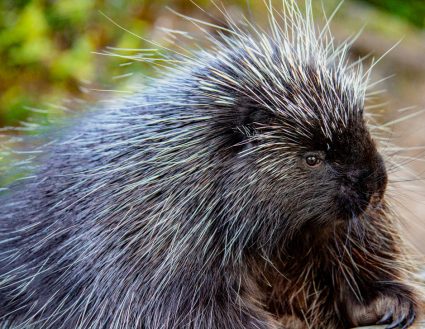
You might be familiar with hedgehogs because they are popular pets or perhaps you’re a fan of Sonic the Hedgehog. But did you know that hedgehogs also live in the wild?

Hedgehogs are most recognizable by the spiky quills on their backs. Photo by Callingcurlew23 / iStock.com.
There are 17 species of hedgehogs, ranging in size from 13-30 cm (5-12 in.) long and weighing up to 1.2 kg (2.6 lb.). They are most recognizable by the spiky brown quills which cover their backs.
Hedgehogs are native to Europe, Africa, and Asia. But they also live in New Zealand as an invasive species.
They can be found in a variety of habitats, including woodlands, grasslands, farmlands, as well as urban and suburban areas.
In fact, the name ‘hedgehog’ came about because hedgehogs often live in hedgerows. The ‘hog’ part of the name is due to their pig-like grunts as they search for food, but they’re not related to pigs.
Hedgehogs are also not related to porcupines or echidnas, despite all three being spiky animals. Hedgehogs are actually small mammals more closely related to shrews.
Hedgehog Spines
On average, an adult hedgehog has about 5000-7000 spines, or quills, on its back. The spines are 2.5 cm (1 in.) long. They are hollow modified hairs made of keratin (the material in your fingernails and hair).
Unlike porcupine quills, hedgehog quills do not detach easily from their bodies, and they are not barbed. But hedgehog spines are sharp, and hedgehogs can raise them up using muscles in their backs.
When hedgehogs are threatened, they curl up into a tight ball. They tuck their head, tail, and legs in and stick their quills out.

Photo by Callingcurlew23 / iStock.com
Poisonous Saliva?
Hedgehogs chew up poisonous plants (which they are immune to) and make a frothy saliva in their mouths. Then they lick the poisonous saliva mixture all over their spines.
This behavior–when an animal covers their body with a scented substance–is called anointing or self-anointing.
Anointing helps hedgehogs hide their scent from predators. It also dissuades predators from taking a bite if they do come in contact.
Night Animals
Hedgehogs are mostly nocturnal, which means they’re active at night. At night, they can travel as far as 1-2 km (~1 mi.) in search of food!
Typically, hedgehogs sleep during the day under rocks, bushes or in underground dens. But they are sometimes active during the day as well, particularly after it has rained.

Photo by Maren Winter / iStock.com.
Winter Hibernation
From November to mid-March, hedgehogs hibernate for winter. Their body temperature goes from 30-35°C (86-95°F) all the way down to 2-5°C (36-41°F)!
Their heart rate and breathing slow down substantially to conserve energy. Normally, a hedgehog’s heart rate is 188 beats per minute. In hibernation, its heart slows to just 21 beats per minute.
What Hedgehogs Eat
Hedgehogs mostly eat insects, but they also dine on worms, slugs, small mice, frogs, baby birds, snakes, bird eggs, fruit, and mushrooms.
Because hedgehogs eat both meat and plants, that makes them omnivores. They find their food with their excellent sense of smell and hearing. They do not have particularly good eyesight.
How Hedgehogs Move
Real hedgehogs may not be as fast as Sonic the Hedgehog, but they can run about 9.5 km/h (5 mph) in short bursts.
Hedgehogs are also pretty good climbers, and they can also swim!

Photo by kwasny221 / iStock.com
Reproduction
Hedgehogs breed from April-September, during which time, the female hedgehog will make a nest of leaves and grass.
After a gestation period of 30-40 days, the female will typically give birth to four to five babies, called hoglets.
Baby hedgehogs are born pink and blind. Their spines are soft and short and covered in a protective membrane.

Hedgehog babies are called hoglets! Photo by Leonid Eremeychuk / iStock.com.
Soon after birth, the membrane dries and falls off. In a couple weeks, the hoglets’ spines harden while growing longer and sharper.
At three weeks, the babies are ready to leave the nest, and they venture out with their mother to find food. By five to six weeks, the babies are ready to live on their own.
At ten weeks, the hoglets go through a process called quilling, where they lose their baby quills and grow in adult quills.
In the wild, hedgehogs live about four years. Predators of hedgehogs include badgers, owls, ferrets, foxes, wolves, and mongooses.
Conservation Status
The IUCN Red List classifies most species of hedgehogs as species of least concern. However, the Western European hedgehog is listed as near threatened. Threats include habitat fragmentation, garden chemicals, and being struck by cars.
In New Zealand, hedgehogs are an invasive species. European hedgehogs were first introduced in New Zealand in the 1870s by British settlers. With few natural predators, hedgehog numbers have since skyrocketed there.
Invasive species are problematic because they disrupt the native ecosystem by outcompeting native species for food or by preying upon native species.
What You Can Do to Help
If you live in an area native to hedgehogs, there are a few things you can do to help them. First, don’t use pesticides in your garden as they can be deadly to hedgehogs.
Further, hedgehogs need a lot of room to roam. Make your garden accessible to hedgehogs by cutting small holes at the bottom of close-board fences and gates so they can pass through. Encourage your neighbors to do the same.
Hedgehog Range

Hedgehogs are native to Europe, Africa, and Asia. But they also live in New Zealand as an invasive species.
More Hedgehog Resources
- The Natural History Museum: European hedgehog (Erinaceus europaeus)
- National Geographic Kids: Hedgehog Facts!
- World Wildlife Fund: Top 10 Facts about Hedgehogs
- Predator Free NZ: 7 Surprising Facts about Hedgehogs
- BBC Earth: Our Prickly Little Friends
- Nature: Heart-beat of the Hibernating Hedgehog
Quick Fact Sheet

Common Name(s): Hedgehog
Scientific Name: Erinaceinae
Animal Type: mammal
Size: 13-30 cm (5-12 in.) long; Tail: 2.5-5 cm (1-2 in.)
Weight: Up to 1.2 kg (2.6 lb.)
Lifespan: 4 years in the wild
About the Author

Abi Cushman is a contributing editor of Animal Fact Guide and My House Rabbit. She is also an award-winning author and illustrator of funny picture books for kids, including Soaked!, Animals Go Vroom!, and Wombats Are Pretty Weird.
To learn more and to download free activity sheets, visit AbiCushman.com.