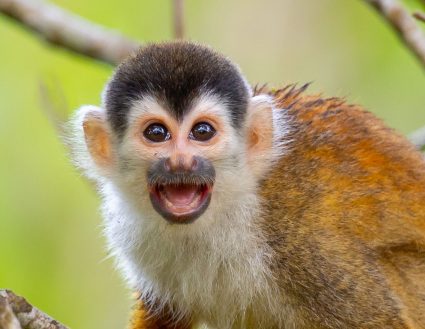
Did you know the guereza colobus monkey spends almost its entire life up in the treetops?

Photo by CraigRJD / iStock.com.
Living in forests throughout central Africa, the guereza colobus monkey rarely descends to the ground–not even for water! It can get enough water from its food and from the dew on leaves.
For this reason, the guereza colobus takes the title as Africa’s most arboreal (tree-dwelling) monkey.
Also known as the mantled guereza and the eastern black-and-white colobus, this monkey has mostly black fur on its body with long white fur on its back creating a mantle (or cape). It has a long bushy tail and a ring of white around its face.
Guereza colobuses are about 60 cm (24 in.) tall with tails measuring about 66 cm (27 in.) long. They weigh around 4-14 kg (14-32 lb.).
Spending so much time in trees, the guereza colobus has several adaptations for swinging and sitting on branches.
No Functional Thumbs
The word ‘colobus’ comes from a Greek word meaning ‘mutilated’. This is because colobus monkeys do not have functional thumbs. Their thumbs are just small bumps.
However, despite being called ‘mutilated’, the lack of thumbs actually streamlines their ability to swing from branch to branch. Their fingers are long and hook onto the branches easily without thumbs to get in the way.
Natural Parachute
The long mantle of the guereza colobus acts like a parachute as it swoops down to catch the next branch. Its tail acts like a rudder to help keep balance.

Black-and-white colobus monkeys traveling between the tree branches in Laikipia County, Kenya. Photo by pilesasmiles / iStock.com.
Opposable Big Toes
When they land, guerezas use their opposable big toes on their feet to help them grasp the branches.
Butt Pads
Guereza colobuses even have a way to get comfy while sitting in branches for long periods of time. Their butts are equipped with pads called ischial callosities. In this way, they have built-in seat cushions.
In fact, guereza colobuses are so well-suited for life in the trees, they only go to the ground when there is no way to get where they need to go from the treetops.

Guerezas have built-in seat cushions! Photo by tane-mahuta / iStock.com.
What Guereza Colobuses Eat
Guereza colobuses mainly eat leaves. On occasion, they also eat fruit, seeds, flowers and bark.
Multi-Chambered Stomachs
Because the leaves are so fibrous and low on nutrition, guerezas have a few adaptations to help with digestion. Enlarged salivary glands help soften the leaves while they chew.
Special multi-chambered stomachs (similar to a cow) allow them to pull out as many nutrients as possible during the digestive process. And specialized bacteria in their stomachs helps break down the leaves even further.

Black-and-white colobus monkeys in a tree in Uganda. Photo by Wildnerdpix / iStock.com.
Social Life
Guereza colobuses are social animals. They live in groups of 8-15 with one dominant male, several females, and their young.
Each troop (group of monkeys) has their own territory, and the male lets out loud croaking roars to tell other guereza troops to keep their distance. He will also chase others away if needed.
During the day, guereza colobuses spend their time eating, traveling as a group, and resting. At night, one monkey acts as a sentry while the others sleep, keeping watch for predators such as leopards, hawks, and chimpanzees.
Guereza Colobus Reproduction
After a 4-6 month gestation period, guereza colobuses give birth to a single infant.
A newborn guereza has all white fur with a pink face. Other females in the group help the mother care for the baby. And at about 3 months, the black fur starts to grow in.

Two week old mantled guereza baby. Photo by miroslav_1 / iStock.com.
Female young will stay with the troop for their whole lives. Male young will leave the group when they mature.
They then live alone or in small bachelor groups until they can take over another troop.
In the wild, guereza colobuses live about 20 years.
Conservation Status
Though the IUCN Red List classifies guereza colobus monkeys as a species of least concern, they are threatened by habitat loss as well as fur hunting.
What You Can Do to Help
You can help guereza colobus monkeys by supporting the African Wildlife Foundation.
Guereza Colobus Monkey Range

Guereza colobus monkeys live in forests throughout central Africa.
More Guereza Colobus Resources
- L.A. Zoo: Black-and-White Colobus
- African Wildlife Foundation: Colobus Monkey
- Minnesota Zoo: Black and White Colobus Monkey
- San Francisco Zoo: Black and White Colobus Monkey
- New England Primate Conservancy: Guereza Colobus
Quick Fact Sheet

Common Name(s): Guereza Colobus Monkey, Mantled Guereza, Eastern Black-and-White Colobus
Scientific Name: Colobus guereza
Animal Type: mammal
Size: 60 cm (24 in.) tall; Tail: 66 cm (27 in.)
Weight: 4-14 kg (14-32 lb.)
Lifespan: 20 years
Conservation Status: Least Concern
About the Author

Abi Cushman is a contributing editor of Animal Fact Guide and My House Rabbit. When she's not writing about weird animal facts, Abi writes and illustrates funny books for kids. Her picture books, Soaked! and Animals Go Vroom!, are available now from Viking Children's Books.
To learn more and to download free activity sheets, visit www.abicushman.com. Follow her on Instagram at @Abi.Cushman.